Kansas City has many highly regarded golf courses around and beyond the urban core.
While several of these courses are located within country clubs that bring together the city’s elite, the origin of golf in Kansas City started out quite the opposite.
Kansas City’s First Golf Course
Golf, a sport deeply rooted in Scottish tradition, made its way to Kansas City in the late 19th century.
As the sport gained traction across the United States, a group of Kansas City residents, many with Scottish ancestry, embraced golf as both a leisure activity and a symbol of modernity.
This enthusiasm culminated in the creation of Kansas City’s first golf course: the Kenwood Golf Links, located in the heart of the Hyde Park neighborhood.
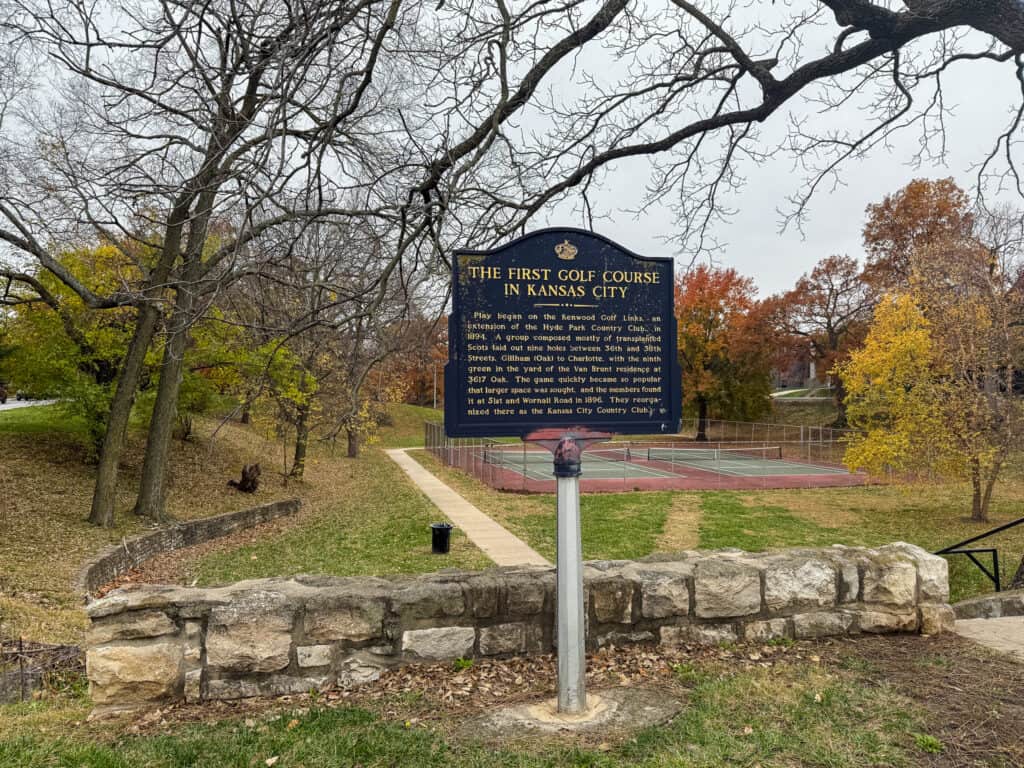
Driving along Gillham Road now, you could easily miss this green space, which has since been turned into tennis courts and a native garden.
The Origins of the Kenwood Golf Links
In 1894, the Kenwood Golf Links was established as a nine-hole course in what is now the Hyde Park neighborhood.
The course stretched roughly between 34th and 36th Streets, with its boundaries defined by Gillham Road (then known as Oak Street) and Charlotte Street.
Unlike the meticulously landscaped courses we know today, the Kenwood Golf Links was a simple layout that utilized the natural terrain. Players navigated grassy fairways, uneven surfaces, and natural features such as trees and creeks.
Maintenance of the course was a community effort. Golfers themselves were responsible for trimming the greens, often bringing their own lawnmowers to prepare the course before play.
A Course with Unique Features
One of the course’s most charming quirks was its ninth hole, which concluded directly in the backyard of Henry Van Brunt, a prominent architect whose residence was located at 3617 Oak Street.
Van Brunt, known for designing iconic buildings like the Union Station in Kansas City, was a member of the golf club and graciously allowed his backyard to serve as part of the course.
The Rise of the Kansas City Country Club
The popularity of the Kenwood Golf Links spurred the formation of the Kansas City Country Club (KCCC) in 1896. This history makes the Kansas City Country Club one of the oldest country clubs west of the Mississippi River.
While the Kenwood course had been adequate for the fledgling golf community, the club’s founders aspired to create a more expansive and sophisticated facility.
The Kansas City Country Club moved to a larger site at 51st Street and Wornall Road, where it developed an 18-hole course. This new location, with its manicured greens and a grand clubhouse, became a hub for the city’s elite.
The land was eventually sold, prompting the club to move yet again in 1927 – this time to Mission Hills. This move coincided with the development of nearby Country Club Plaza in 1923, which brought about the growth of this area of midtown under J.C. Nichols who sought to create neighborhoods for the wealthy.
In recent decades, Nichols tactics of redlining the city’s east side residents during this era have been brought to light.
What Remains of Kenwood Golf Links
The original site of the Kenwood Golf Links has since been redeveloped into a residential park, erasing much of the physical evidence of the course.
However, its historical significance has not been forgotten. A historical marker at the corner of 36th Street and Gillham Road commemorates the site as Kansas City’s first golf course, ensuring that the legacy of the Kenwood Golf Links is preserved.
Gillham Road, once a boundary for the Kenwood course, has also become a focal point of historical pride.
The area is home to Gillham Park, a green space that continues to serve as a recreational haven for Kansas City residents.
Golf in Kansas City Today
The founding of the Kenwood Golf Links not only introduced Kansas City to the game of golf but also reflected the city’s aspirations during the Gilded Age.
Today, the Kansas City Country Club is one of the most prestigious clubs in the region. Over the years, the course has hosted many regional and national tournaments, and the club is home to five-time British Open Champion, Tom Watson.
The legacy of the Kansas City Country Club and all that has come from it can be traced directly back to the humble beginnings of the Kenwood Golf Links, a course that, despite its simplicity, laid the foundation for golf culture in KC.